New York's "Egg Giveaway" Battle: Polymarket Opens a Store, Kalshi Issues Coupons, What Are the Giants Up To?

marsbitPublished on 2026-02-04Last updated on 2026-02-04

Abstract

Two prediction market giants, Kalshi and Polymarket, are launching offline promotional campaigns in New York to attract users and influence regulatory perception. Ahead of the Super Bowl, Kalshi offered $50 worth of free groceries at a local market through a limited-time pop-up event, encouraging participation in low-stakes predictions like local gas price changes. Polymarket went further, announcing the opening of a “free grocery store” in New York and donating $1 million to a food bank, while distributing free produce like tomatoes and eggs—a tactic reminiscent of classic user-acquisition strategies in China. The $50 offer holds significant value in New York: it can buy about 1.5 pounds of beef, five McDonald’s meals, or cover two days of food for an average person. Both campaigns drew considerable public attention, with long queues reported. Beyond user growth, these moves appear strategically timed amid regulatory scrutiny. New York state lawmakers are considering bills to restrict prediction markets, likening them to unregulated gambling. By addressing food affordability—a key issue aligned with local political discourse—Kalshi and Polymarket may be attempting to shape a more favorable regulatory environment, even though direct oversight falls to state and federal authorities.

"Each generation has its own eggs to claim," and the value of this statement continues to rise!

This time, the two titans of the prediction market—Kalshi and Polymarket—are the ones stirring up this egg scramble.

In a bid to grab more attention ahead of the "American Super Bowl," the two platforms recently launched their own "offline promotion performances"—Kalshi offered users $50 worth of free groceries at a market in New York; Polymarket went even further, unveiling its months-in-the-making "first free grocery store in New York," set to open on February 12. In the battle for attention and user growth, the prediction market giants, valued at billions, have chosen the oldest but most effective route: "ground-level offline promotions."

Regarding this, we immediately contacted our New York-based colleague Connie for the latest on "Kalshi and Polymarket's offline promotions" and practical details like "how much can $50 actually buy in New York City?" to share with our readers.

When Prediction Market Giants Dive into Offline Promotions: Kalshi's Pop-Up, Polymarket's "Instant Store Launch"

As one of America's premier metropolises, New York has become a crucial battleground and focal point for Kalshi and Polymarket, the two prediction market giants.

Addressing the growing cost-of-living pressures in New York and across the U.S., both Kalshi and Polymarket have rolled out major initiatives—

On February 3, Kalshi offered select users a【limited-time】$50 free grocery benefit at Westside Market on Third Avenue and 84th Street, aiming to attract more users to participate in various real-world event predictions on their platform.

Judging from the surrounding "flyers," "supermarket posters," and other materials, Kalshi's offline promotion resembled an impromptu "pop-up event"—partnering with a local market to deploy temporary offline materials, using "free $50 worth of groceries" as bait to draw crowds to line up and engage. This was confirmed by Connie.

Additionally, through this pop-up, Kalshi hopes to attract more people to join prediction markets with accessible, low-barrier questions like "Will New York City's gas prices exceed $3.3 this year?" thereby achieving brand marketing and user acquisition goals.


Compared to Kalshi's somewhat rough and highly commercial approach, Polymarket's preparations were undoubtedly more thorough.

On February 3, slightly ahead of Kalshi's announcement, Polymarket officially announced that after months of careful planning, it plans to open "New York's first free grocery store" on February 12 (EST) by leasing a physical storefront. Additionally, Polymarket donated $1 million to the New York City Food Bank to address the region's "hunger issues."

Polymarket also released actual photos of distributing vegetables like tomatoes and eggplants offline, instantly reminiscent of the domestic internet platform promotion era, full of "download the APP get free eggs" and "first recharge gift package" vibes.
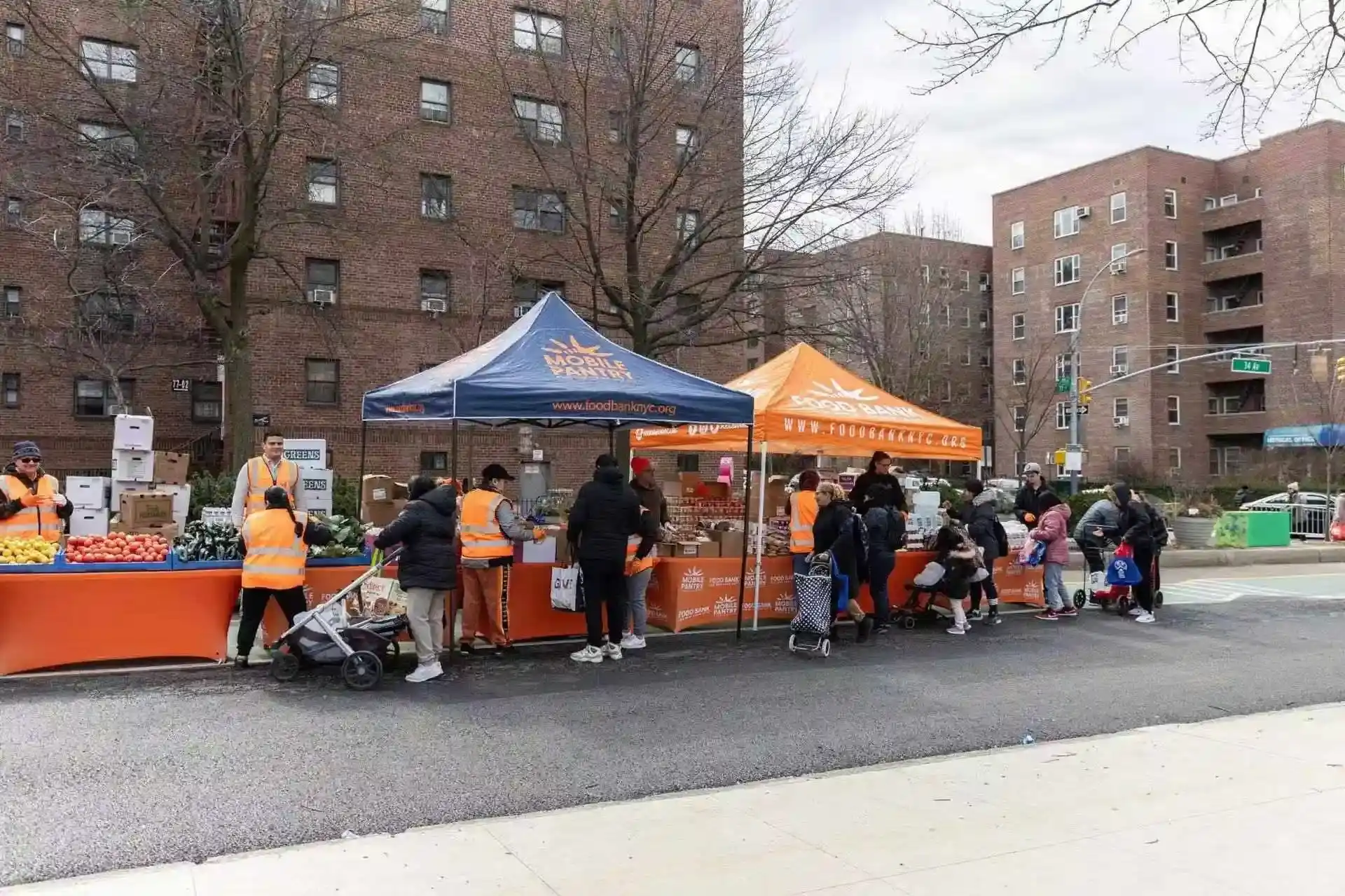
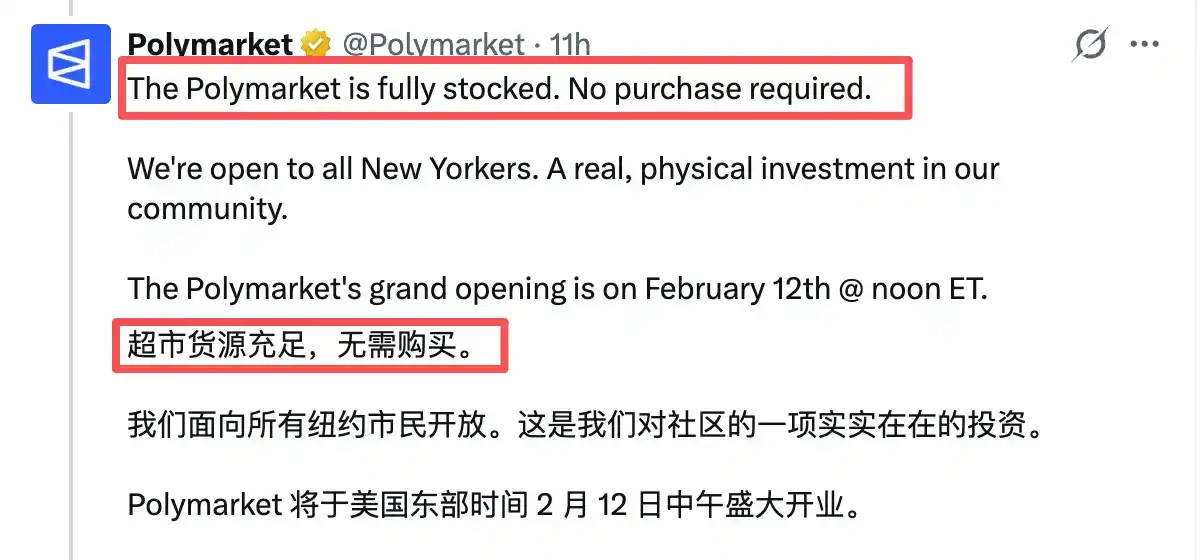
It's worth noting that Polymarket not only emphasized that "Polymarket's offline store is well-stocked, no purchase necessary" but also ended its post by encouraging donations to the New York City Food Bank, urging people to take practical action to address the real "hunger issues" caused by high food costs and the soaring cost of living.
Seeing this, one can't help but remark—

Fake crypto project promotions: Host offline conferences, feast on seafood, shill various scam tokens;

Real crypto project promotions: Give away vegetables, eggs, open offline stores for free food, engage in charity and public welfare, call for donations and compassion.

Regarding the actual purchasing power of Kalshi and Polymarket's "egg collection activities," we also discussed in detail with Connie.

The Real Purchasing Power of $50 in New York, USA: 5 McDonald's Meals, 1.5 lbs of Beef, or 2 Days of Food for the Average Person

According to Connie, $50 holds considerable value in New York City.

"Buying a 0.5 lb (about 0.45 kg) portion of beef at a local New York supermarket costs around $18, so $50 can buy about 1.5 lbs of beef"—enough protein for an adult's three meals a day. For comparison, a pound of beef in China costs only about 30 yuan, roughly 1/8th the cost in New York.

Converting to the well-known "Big Mac Index," the real purchasing power of $50 is quite impressive—a cheeseburger meal外卖 (takeout) with 800-1000 calories costs about $10.89, so $50 can buy about 5 meals; a double burger with 580 calories costs only about $7.20. Of course, these prices are "sky-high" compared to China, where the same burger meal costs only 25-40 yuan, half the price of New York's.
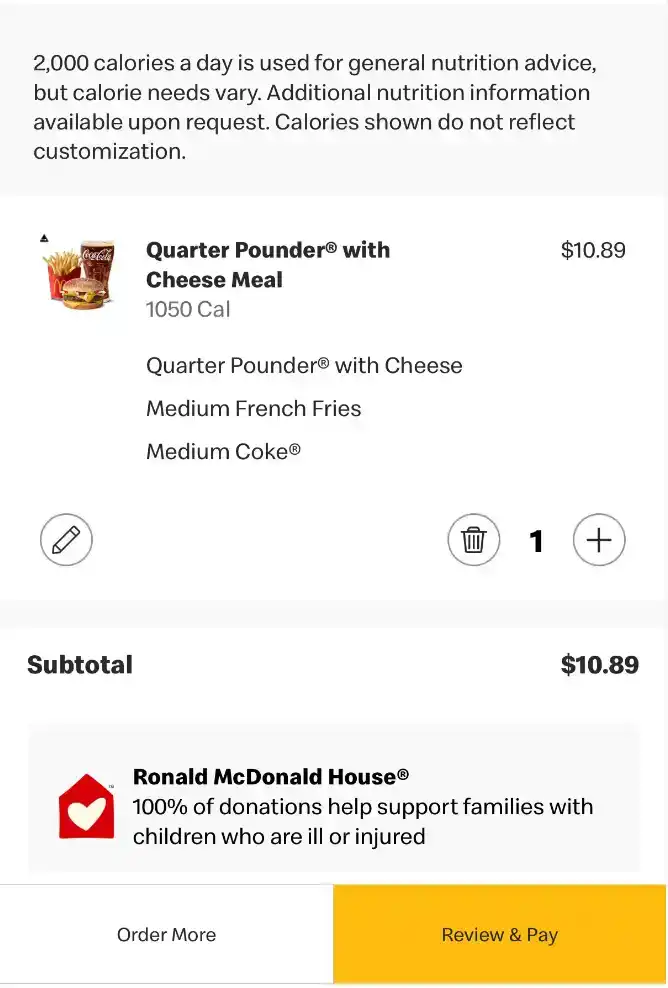
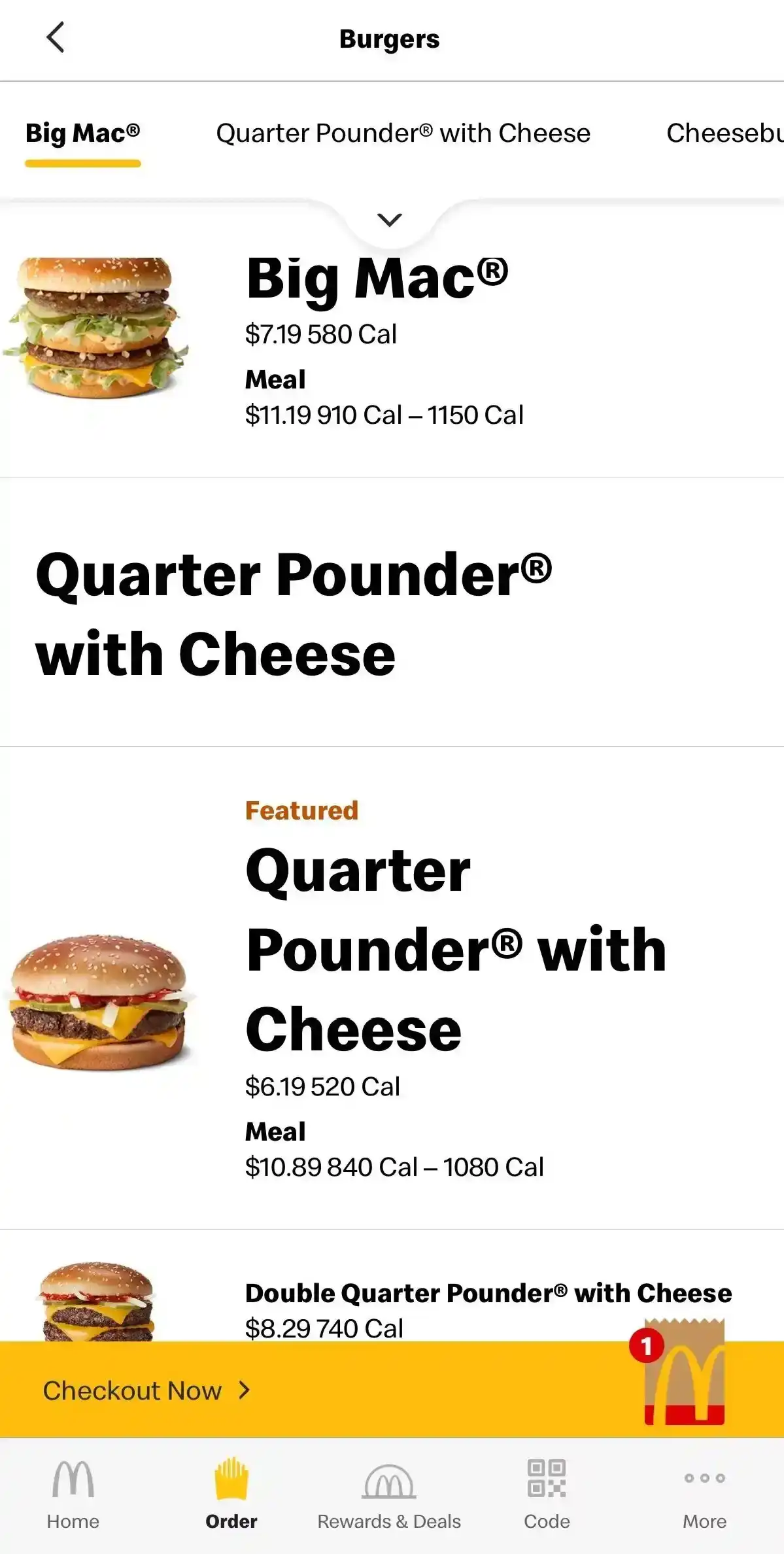
In other words, spent frugally, $50 can nearly cover an average person's food costs for about 2 days in New York (based on 5-6 meals). According to Connie, Kalshi's event attracted many Americans to line up for "free food," and "Americans' enthusiasm for queuing for freebies might even surpass that of Chinese people." Polymarket's "offline free grocery store" is also expected to draw large crowds. Based on the information released by Kalshi and Polymarket, the hard costs for these campaigns are likely at least $50,000 to $100,000.

Beyond charity and compassion, Kalshi and Polymarket have their own "business calculations" behind these substantial investments in manpower and resources.

The "Business Strategy" Behind Prediction Platforms' "Egg Giveaways": Influencing Institutional Regulation with Political Issues

Both Kalshi and Polymarket's food donation activities were conducted without coordination or communication with the New York City government; they are voluntary corporate actions.

However, the wording and objectives of their public statements closely align with the "policies" repeatedly emphasized by New York's new mayor, Zohran Mamdani, during his campaign—he proposed "opening publicly owned grocery stores in New York's five boroughs to lower food prices." Zohran Mamdani noted that city-run stores could reduce rental and operational costs through non-profit models and the use of public property. This proposal is still in the pilot stage, with no final implementation timeline yet determined.

On another front, as a key state, New York's legislators are busy drafting new bills targeting the emerging prediction market industry. Among them, the "ORACLE Act" aims to restrict or prohibit New York residents from betting on certain prediction market events and impose stricter regulations on event-based prediction markets; another piece of legislation plans to require prediction market operators to obtain a state-issued license before operating.

It's clear that some lawmakers still have concerns about prediction markets, viewing them as akin to unregulated gambling or susceptible to insider manipulation.

Given this, although the New York mayor has no direct jurisdiction over prediction market regulation (author's note: regulatory authority for prediction market platforms lies with state and federal governments), Kalshi and Polymarket's actions might be an attempt to indirectly seek more favorable regulations.

Finally, regardless of the ultimate impact of their "egg giveaway" efforts, we must admit that Chinese internet platforms' promotion models are likely at least 5-10 years ahead of the Western world.


Related Questions

QWhat are Kalshi and Polymarket doing in New York to attract users and what is the main goal of their campaigns?

AKalshi is distributing $50 worth of free food at a local market as a limited-time flash event, while Polymarket is opening a free grocery store in New York and has donated $1 million to the New York City Food Bank. Their main goal is to attract more users to their prediction market platforms, increase brand visibility, and potentially influence regulatory perceptions through public goodwill.

QHow does the purchasing power of $50 in New York compare to China, according to the article?

AIn New York, $50 can buy about 1.5 pounds of beef or 5 McDonald's cheeseburger meals, which is enough for approximately 2 days of meals for an average person. In contrast, the same amount of beef costs about one-eighth of the price in China, and a McDonald's meal is about half the cost compared to New York.

QWhat regulatory challenges are prediction markets like Kalshi and Polymarket facing in New York?

ANew York lawmakers are considering legislation such as the ORACLE Act, which aims to restrict or ban residents from betting on certain prediction market events and impose stricter regulations. Some legislators view prediction markets as unregulated gambling or susceptible to insider manipulation, leading to potential licensing requirements and tighter controls.

QHow does Polymarket's approach to 'giving away eggs' differ from typical crypto project promotions?

AUnlike typical crypto project promotions that involve hosting conferences, expensive dinners, and promoting speculative tokens, Polymarket's approach focuses on practical benefits like giving away free vegetables, eggs, and groceries, donating to charity, and encouraging public donations to address real-world issues like hunger and high living costs.

QWhat political context in New York is related to the actions of Kalshi and Polymarket, even though they didn't coordinate with the government?

ATheir initiatives align with New York Mayor Zohran Mamdani's campaign proposal to open publicly owned grocery stores to lower food prices, though his plan is still in the pilot stage. While the mayor has no direct regulatory authority over prediction markets, their actions may be an attempt to gain favor and influence state-level regulatory attitudes indirectly.

Related Reads

In-depth Analysis of AI and Crypto: The Era of Symbiosis between Algorithms and Ledgers

By 2026, the integration of artificial intelligence and cryptocurrency has advanced from proof-of-concept to a new stage of "system-level integration". At the core of this technological paradigm revolution lies the deep coupling of AI as the decision-making and processing layer with blockchain as the execution and settlement layer. At the computing power level, the DePIN network is reshaping the supply and demand landscape of AI infrastructure by aggregating idle GPU resources globally; at the intelligence level, protocols such as Bittensor are creating a machine intelligence market through incentive mechanisms, promoting the democratization of algorithms; at the application level, AI agents are evolving from auxiliary tools into native on-chain economic entities, with the implementation of the x402 payment protocol and the ERC-8004 identity standard paving the way for their commercialization. Simultaneously, the integrated application of fully homomorphic encryption, zero-knowledge machine learning, and trusted execution environment is constructing a new paradigm of "hybrid confidential computing". Cutting-edge experiments at the Bitcoin Policy Institute reveal a stunning future: when AI models possess economic autonomy, 90.8% of them choose digital native currencies, with 48.3% choosing Bitcoin as their preferred store of value. This transformation is reshaping the logic of global financial infrastructure—future currencies will flow like information, banks will be integrated into the underlying internet infrastructure, and assets will become routable data packets.

HTX Learn45m ago

In-depth Analysis of AI and Crypto: The Era of Symbiosis between Algorithms and Ledgers

HTX Learn45m ago

Trading

Spot
Futures

Hot Articles

What is SONIC

Sonic: Pioneering the Future of Gaming in Web3 Introduction to Sonic In the ever-evolving landscape of Web3, the gaming industry stands out as one of the most dynamic and promising sectors. At the forefront of this revolution is Sonic, a project designed to amplify the gaming ecosystem on the Solana blockchain. Leveraging cutting-edge technology, Sonic aims to deliver an unparalleled gaming experience by efficiently processing millions of requests per second, ensuring that players enjoy seamless gameplay while maintaining low transaction costs. This article delves into the intricate details of Sonic, exploring its creators, funding sources, operational mechanics, and the timeline of significant events that have shaped its journey. What is Sonic? Sonic is an innovative layer-2 network that operates atop the Solana blockchain, specifically tailored to enhance the existing Solana gaming ecosystem. It accomplishes this through a customised, VM-agnostic game engine paired with a HyperGrid interpreter, facilitating sovereign game economies that roll up back to the Solana platform. The primary goals of Sonic include: Enhanced Gaming Experiences: Sonic is committed to offering lightning-fast on-chain gameplay, allowing players and developers to engage with games at previously unattainable speeds. Atomic Interoperability: This feature enables transactions to be executed within Sonic without the need to redeploy Solana programmes and accounts. This makes the process more efficient and directly benefits from Solana Layer1 services and liquidity. Seamless Deployment: Sonic allows developers to write for Ethereum Virtual Machine (EVM) based systems and execute them on Solana’s SVM infrastructure. This interoperability is crucial for attracting a broader range of dApps and decentralised applications to the platform. Support for Developers: By offering native composable gaming primitives and extensible data types - dining within the Entity-Component-System (ECS) framework - game creators can craft intricate business logic with ease. Overall, Sonic's unique approach not only caters to players but also provides an accessible and low-cost environment for developers to innovate and thrive. Creator of Sonic The information regarding the creator of Sonic is somewhat ambiguous. However, it is known that Sonic's SVM is owned by the company Mirror World. The absence of detailed information about the individuals behind Sonic reflects a common trend in several Web3 projects, where collective efforts and partnerships often overshadow individual contributions. Investors of Sonic Sonic has garnered considerable attention and support from various investors within the crypto and gaming sectors. Notably, the project raised an impressive $12 million during its Series A funding round. The round was led by BITKRAFT Ventures, with other notable investors including Galaxy, Okx Ventures, Interactive, Big Brain Holdings, and Mirana. This financial backing signifies the confidence that investment foundations have in Sonic’s potential to revolutionise the Web3 gaming landscape, further validating its innovative approaches and technologies. How Does Sonic Work? Sonic utilises the HyperGrid framework, a sophisticated parallel processing mechanism that enhances its scalability and customisability. Here are the core features that set Sonic apart: Lightning Speed at Low Costs: Sonic offers one of the fastest on-chain gaming experiences compared to other Layer-1 solutions, powered by the scalability of Solana’s virtual machine (SVM). Atomic Interoperability: Sonic enables transaction execution without redeployment of Solana programmes and accounts, effectively streamlining the interaction between users and the blockchain. EVM Compatibility: Developers can effortlessly migrate decentralised applications from EVM chains to the Solana environment using Sonic’s HyperGrid interpreter, increasing the accessibility and integration of various dApps. Ecosystem Support for Developers: By exposing native composable gaming primitives, Sonic facilitates a sandbox-like environment where developers can experiment and implement business logic, greatly enhancing the overall development experience. Monetisation Infrastructure: Sonic natively supports growth and monetisation efforts, providing frameworks for traffic generation, payments, and settlements, thereby ensuring that gaming projects are not only viable but also sustainable financially. Timeline of Sonic The evolution of Sonic has been marked by several key milestones. Below is a brief timeline highlighting critical events in the project's history: 2022: The Sonic cryptocurrency was officially launched, marking the beginning of its journey in the Web3 gaming arena. 2024: June: Sonic SVM successfully raised $12 million in a Series A funding round. This investment allowed Sonic to further develop its platform and expand its offerings. August: The launch of the Sonic Odyssey testnet provided users with the first opportunity to engage with the platform, offering interactive activities such as collecting rings—a nod to gaming nostalgia. October: SonicX, an innovative crypto game integrated with Solana, made its debut on TikTok, capturing the attention of over 120,000 users within a short span. This integration illustrated Sonic’s commitment to reaching a broader, global audience and showcased the potential of blockchain gaming. Key Points Sonic SVM is a revolutionary layer-2 network on Solana explicitly designed to enhance the GameFi landscape, demonstrating great potential for future development. HyperGrid Framework empowers Sonic by introducing horizontal scaling capabilities, ensuring that the network can handle the demands of Web3 gaming. Integration with Social Platforms: The successful launch of SonicX on TikTok displays Sonic’s strategy to leverage social media platforms to engage users, exponentially increasing the exposure and reach of its projects. Investment Confidence: The substantial funding from BITKRAFT Ventures, among others, emphasizes the robust backing Sonic has, paving the way for its ambitious future. In conclusion, Sonic encapsulates the essence of Web3 gaming innovation, striking a balance between cutting-edge technology, developer-centric tools, and community engagement. As the project continues to evolve, it is poised to redefine the gaming landscape, making it a notable entity for gamers and developers alike. As Sonic moves forward, it will undoubtedly attract greater interest and participation, solidifying its place within the broader narrative of blockchain gaming.

858 Total ViewsPublished 2024.04.04Updated 2024.12.03

What is SONIC

What is $S$

Understanding SPERO: A Comprehensive Overview Introduction to SPERO As the landscape of innovation continues to evolve, the emergence of web3 technologies and cryptocurrency projects plays a pivotal role in shaping the digital future. One project that has garnered attention in this dynamic field is SPERO, denoted as SPERO,$$s$. This article aims to gather and present detailed information about SPERO, to help enthusiasts and investors understand its foundations, objectives, and innovations within the web3 and crypto domains. What is SPERO,$$s$? SPERO,$$s$ is a unique project within the crypto space that seeks to leverage the principles of decentralisation and blockchain technology to create an ecosystem that promotes engagement, utility, and financial inclusion. The project is tailored to facilitate peer-to-peer interactions in new ways, providing users with innovative financial solutions and services. At its core, SPERO,$$s$ aims to empower individuals by providing tools and platforms that enhance user experience in the cryptocurrency space. This includes enabling more flexible transaction methods, fostering community-driven initiatives, and creating pathways for financial opportunities through decentralised applications (dApps). The underlying vision of SPERO,$$s$ revolves around inclusiveness, aiming to bridge gaps within traditional finance while harnessing the benefits of blockchain technology. Who is the Creator of SPERO,$$s$? The identity of the creator of SPERO,$$s$ remains somewhat obscure, as there are limited publicly available resources providing detailed background information on its founder(s). This lack of transparency can stem from the project's commitment to decentralisation—an ethos that many web3 projects share, prioritising collective contributions over individual recognition. By centring discussions around the community and its collective goals, SPERO,$$s$ embodies the essence of empowerment without singling out specific individuals. As such, understanding the ethos and mission of SPERO remains more important than identifying a singular creator. Who are the Investors of SPERO,$$s$? SPERO,$$s$ is supported by a diverse array of investors ranging from venture capitalists to angel investors dedicated to fostering innovation in the crypto sector. The focus of these investors generally aligns with SPERO's mission—prioritising projects that promise societal technological advancement, financial inclusivity, and decentralised governance. These investor foundations are typically interested in projects that not only offer innovative products but also contribute positively to the blockchain community and its ecosystems. The backing from these investors reinforces SPERO,$$s$ as a noteworthy contender in the rapidly evolving domain of crypto projects. How Does SPERO,$$s$ Work? SPERO,$$s$ employs a multi-faceted framework that distinguishes it from conventional cryptocurrency projects. Here are some of the key features that underline its uniqueness and innovation: Decentralised Governance: SPERO,$$s$ integrates decentralised governance models, empowering users to participate actively in decision-making processes regarding the project’s future. This approach fosters a sense of ownership and accountability among community members. Token Utility: SPERO,$$s$ utilises its own cryptocurrency token, designed to serve various functions within the ecosystem. These tokens enable transactions, rewards, and the facilitation of services offered on the platform, enhancing overall engagement and utility. Layered Architecture: The technical architecture of SPERO,$$s$ supports modularity and scalability, allowing for seamless integration of additional features and applications as the project evolves. This adaptability is paramount for sustaining relevance in the ever-changing crypto landscape. Community Engagement: The project emphasises community-driven initiatives, employing mechanisms that incentivise collaboration and feedback. By nurturing a strong community, SPERO,$$s$ can better address user needs and adapt to market trends. Focus on Inclusion: By offering low transaction fees and user-friendly interfaces, SPERO,$$s$ aims to attract a diverse user base, including individuals who may not previously have engaged in the crypto space. This commitment to inclusion aligns with its overarching mission of empowerment through accessibility. Timeline of SPERO,$$s$ Understanding a project's history provides crucial insights into its development trajectory and milestones. Below is a suggested timeline mapping significant events in the evolution of SPERO,$$s$: Conceptualisation and Ideation Phase: The initial ideas forming the basis of SPERO,$$s$ were conceived, aligning closely with the principles of decentralisation and community focus within the blockchain industry. Launch of Project Whitepaper: Following the conceptual phase, a comprehensive whitepaper detailing the vision, goals, and technological infrastructure of SPERO,$$s$ was released to garner community interest and feedback. Community Building and Early Engagements: Active outreach efforts were made to build a community of early adopters and potential investors, facilitating discussions around the project’s goals and garnering support. Token Generation Event: SPERO,$$s$ conducted a token generation event (TGE) to distribute its native tokens to early supporters and establish initial liquidity within the ecosystem. Launch of Initial dApp: The first decentralised application (dApp) associated with SPERO,$$s$ went live, allowing users to engage with the platform's core functionalities. Ongoing Development and Partnerships: Continuous updates and enhancements to the project's offerings, including strategic partnerships with other players in the blockchain space, have shaped SPERO,$$s$ into a competitive and evolving player in the crypto market. Conclusion SPERO,$$s$ stands as a testament to the potential of web3 and cryptocurrency to revolutionise financial systems and empower individuals. With a commitment to decentralised governance, community engagement, and innovatively designed functionalities, it paves the way toward a more inclusive financial landscape. As with any investment in the rapidly evolving crypto space, potential investors and users are encouraged to research thoroughly and engage thoughtfully with the ongoing developments within SPERO,$$s$. The project showcases the innovative spirit of the crypto industry, inviting further exploration into its myriad possibilities. While the journey of SPERO,$$s$ is still unfolding, its foundational principles may indeed influence the future of how we interact with technology, finance, and each other in interconnected digital ecosystems.

54 Total ViewsPublished 2024.12.17Updated 2024.12.17

What is $S$

What is AGENT S

Agent S: The Future of Autonomous Interaction in Web3 Introduction In the ever-evolving landscape of Web3 and cryptocurrency, innovations are constantly redefining how individuals interact with digital platforms. One such pioneering project, Agent S, promises to revolutionise human-computer interaction through its open agentic framework. By paving the way for autonomous interactions, Agent S aims to simplify complex tasks, offering transformative applications in artificial intelligence (AI). This detailed exploration will delve into the project's intricacies, its unique features, and the implications for the cryptocurrency domain. What is Agent S? Agent S stands as a groundbreaking open agentic framework, specifically designed to tackle three fundamental challenges in the automation of computer tasks: Acquiring Domain-Specific Knowledge: The framework intelligently learns from various external knowledge sources and internal experiences. This dual approach empowers it to build a rich repository of domain-specific knowledge, enhancing its performance in task execution. Planning Over Long Task Horizons: Agent S employs experience-augmented hierarchical planning, a strategic approach that facilitates efficient breakdown and execution of intricate tasks. This feature significantly enhances its ability to manage multiple subtasks efficiently and effectively. Handling Dynamic, Non-Uniform Interfaces: The project introduces the Agent-Computer Interface (ACI), an innovative solution that enhances the interaction between agents and users. Utilizing Multimodal Large Language Models (MLLMs), Agent S can navigate and manipulate diverse graphical user interfaces seamlessly. Through these pioneering features, Agent S provides a robust framework that addresses the complexities involved in automating human interaction with machines, setting the stage for myriad applications in AI and beyond. Who is the Creator of Agent S? While the concept of Agent S is fundamentally innovative, specific information about its creator remains elusive. The creator is currently unknown, which highlights either the nascent stage of the project or the strategic choice to keep founding members under wraps. Regardless of anonymity, the focus remains on the framework's capabilities and potential. Who are the Investors of Agent S? As Agent S is relatively new in the cryptographic ecosystem, detailed information regarding its investors and financial backers is not explicitly documented. The lack of publicly available insights into the investment foundations or organisations supporting the project raises questions about its funding structure and development roadmap. Understanding the backing is crucial for gauging the project's sustainability and potential market impact. How Does Agent S Work? At the core of Agent S lies cutting-edge technology that enables it to function effectively in diverse settings. Its operational model is built around several key features: Human-like Computer Interaction: The framework offers advanced AI planning, striving to make interactions with computers more intuitive. By mimicking human behaviour in tasks execution, it promises to elevate user experiences. Narrative Memory: Employed to leverage high-level experiences, Agent S utilises narrative memory to keep track of task histories, thereby enhancing its decision-making processes. Episodic Memory: This feature provides users with step-by-step guidance, allowing the framework to offer contextual support as tasks unfold. Support for OpenACI: With the ability to run locally, Agent S allows users to maintain control over their interactions and workflows, aligning with the decentralised ethos of Web3. Easy Integration with External APIs: Its versatility and compatibility with various AI platforms ensure that Agent S can fit seamlessly into existing technological ecosystems, making it an appealing choice for developers and organisations. These functionalities collectively contribute to Agent S's unique position within the crypto space, as it automates complex, multi-step tasks with minimal human intervention. As the project evolves, its potential applications in Web3 could redefine how digital interactions unfold. Timeline of Agent S The development and milestones of Agent S can be encapsulated in a timeline that highlights its significant events: September 27, 2024: The concept of Agent S was launched in a comprehensive research paper titled “An Open Agentic Framework that Uses Computers Like a Human,” showcasing the groundwork for the project. October 10, 2024: The research paper was made publicly available on arXiv, offering an in-depth exploration of the framework and its performance evaluation based on the OSWorld benchmark. October 12, 2024: A video presentation was released, providing a visual insight into the capabilities and features of Agent S, further engaging potential users and investors. These markers in the timeline not only illustrate the progress of Agent S but also indicate its commitment to transparency and community engagement. Key Points About Agent S As the Agent S framework continues to evolve, several key attributes stand out, underscoring its innovative nature and potential: Innovative Framework: Designed to provide an intuitive use of computers akin to human interaction, Agent S brings a novel approach to task automation. Autonomous Interaction: The ability to interact autonomously with computers through GUI signifies a leap towards more intelligent and efficient computing solutions. Complex Task Automation: With its robust methodology, it can automate complex, multi-step tasks, making processes faster and less error-prone. Continuous Improvement: The learning mechanisms enable Agent S to improve from past experiences, continually enhancing its performance and efficacy. Versatility: Its adaptability across different operating environments like OSWorld and WindowsAgentArena ensures that it can serve a broad range of applications. As Agent S positions itself in the Web3 and crypto landscape, its potential to enhance interaction capabilities and automate processes signifies a significant advancement in AI technologies. Through its innovative framework, Agent S exemplifies the future of digital interactions, promising a more seamless and efficient experience for users across various industries. Conclusion Agent S represents a bold leap forward in the marriage of AI and Web3, with the capacity to redefine how we interact with technology. While still in its early stages, the possibilities for its application are vast and compelling. Through its comprehensive framework addressing critical challenges, Agent S aims to bring autonomous interactions to the forefront of the digital experience. As we move deeper into the realms of cryptocurrency and decentralisation, projects like Agent S will undoubtedly play a crucial role in shaping the future of technology and human-computer collaboration.

418 Total ViewsPublished 2025.01.14Updated 2025.01.14

What is AGENT S

Discussions

Welcome to the HTX Community. Here, you can stay informed about the latest platform developments and gain access to professional market insights. Users' opinions on the price of S (S) are presented below.

活动图片